
* Guest contribution by Ibrahim Abdulmajid
In understanding an increasingly complex global landscape, the media plays a central role in shaping particular narratives and perspectives on various topics and issues, including the Uyghur issue in Indonesia. The Chinese government has invested heavily in influence operations that employ disinformation tactics and media propaganda. In this regard, particularly concerning Southeast Asia, the Center for Uyghur Studies has published a special report titled China’s Influence Operations in Southeast Asia and the Uyghur Crisis.
Amid the Chinese government’s extensive disinformation and propaganda operations, Indonesia’s local media plays a crucial role in countering such efforts. But how exactly do Indonesian media outlets report on and frame issues concerning the plight of Uyghur Muslims? Several scholarly journal articles have examined this question. One of them is an article by Betha Dwi Octaviani comparing how Tempo and Antara frame the Uyghur issue.
Tempo is a privately owned media outlet founded in 1971. It was temporarily shut down in 1982 because of its critical coverage of Indonesia’s authoritarian government at the time. In 1994, the Soeharto government shut down Tempo for a second time. Today, Tempo is known for its critical stance toward Indonesia’s domestic political affairs.
Meanwhile, Antara is Indonesia’s national news agency, owned by the Indonesian government. Its origins date back to the colonial era, when it was founded in 1937. At that time, Antara was established as an alternative to the Dutch colonial government’s media, which Indonesian activists believed did not represent the interests of the country’s indigenous population in its reporting.

Between Private and Government Media
In the journal article cited above, Betha found differences in how Tempo and Antara presented news reports about the Uyghur issue. While Tempo covered the issue in the context of alleged human rights violations and drew upon survivor testimonies and reports by international human rights organizations, Antara positioned it within the context of bilateral relations between Indonesia and China. It tended to adopt a “safe” stance to preserve the stability of relations between the two countries.
Drawing upon official reports from international bodies and organizations such as the UN Human Rights Council, the Office of the UN High Commissioner for Human Rights, and Amnesty International, Tempo’s analysis of the Uyghur issue has further exposed systematic measures undertaken by the Chinese government, including the establishment of concentration camps, forced labor, the destruction of mosques, restrictions on religious practices, and other abuses. Meanwhile, Antara’s coverage has avoided these topics and relied only on official statements issued by the Chinese and Indonesian governments.
Tempo also maintains that human rights violations against the Uyghur people are a matter of universal moral responsibility for the international community. Accordingly, people around the world have an obligation to take a stand and speak out in fulfilment of this moral duty. Antara, by contrast, places greater emphasis on the principles of non-intervention and respect for national sovereignty when covering the Uyghur issue.
Overall, a comparison of coverage by these two Indonesian media outlets highlights differences in editorial policies as well as an institutional dilemma. As a privately owned outlet with a record of critically examining both national and international issues, Tempo covers the Uyghur issue critically and frames its reporting through the lens of universal human rights, as international organizations generally do. By contrast, as an official state-owned media outlet, Antara follows a “safe” approach, effectively acting as a spokesperson for the Indonesian government, which has a significant interest in maintaining good relations with China. Consequently, it exercises considerable caution in its reporting.
Shift in Editorial Policy
To understand the dynamics of Antara’s coverage, however, we must consider the context and period in which its reports were published. An analysis of the tone of Antara’s reporting in 2018 and 2019 shows that its narratives and tone were relatively critical regarding the Uyghur issue compared with its coverage since 2020 or 2021. This indicates a shift in Antara’s editorial policy concerning the Uyghur issue.
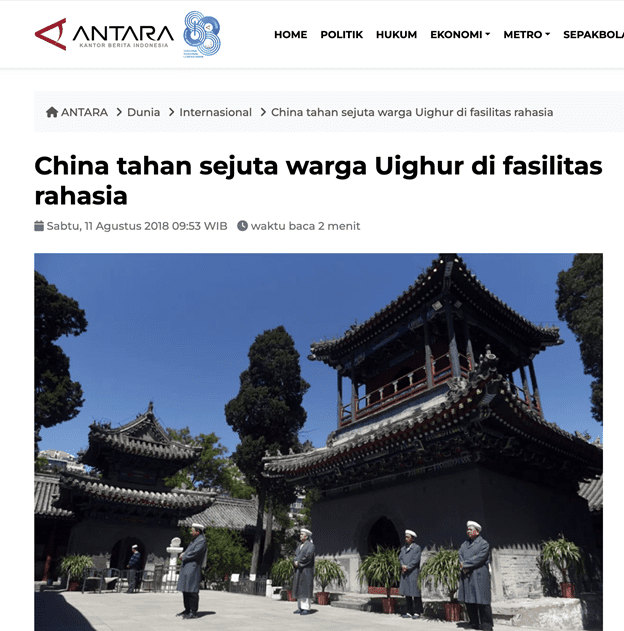
This shift in editorial policy appears to demonstrate the influence of the Chinese government’s diplomatic efforts to suppress critical reporting about the Uyghur issue in Indonesia. It also marks the “deactivation of Islamic diplomacy” during Joko Widodo’s second presidential term.
This means that “Islam” is no longer a central component or consideration in Indonesia’s bilateral diplomacy with China.
In terms of its reporting, Tempo’s status as a privately owned media outlet allows it to operate more independently and remain critical when covering Uyghur issues. Its long history as a critical publication has enabled it to continue standing with minority and oppressed communities amid the Chinese government’s diplomatic and influence operations aimed at silencing critical voices.
The Media’s Unfinished Work
Unfortunately, a random search for news about the Uyghurs over the past two years – 2025 and 2026 – produces very few relevant reports by Indonesia’s mainstream media outlets. This is despite several significant developments concerning the Uyghur issue that have received international media attention, including China’s Ethnic Unity Law.
If this assessment is accurate, it should serve as a warning to Indonesian media outlets concerning their moral responsibility to the public in the face of the human rights abuses endured by the Uyghur people. The international community, and Uyghurs in particular, continue to await a more active role from Indonesia’s media in consistently providing space for Uyghur voices that remain marginalized by political and economic interests.
* Ibrahim Abdulmajid is an Indonesian researcher and educator. He is currently pursing his PhD in social sciences.
Copyright Center for Uyghur Studies - All Rights Reserved